
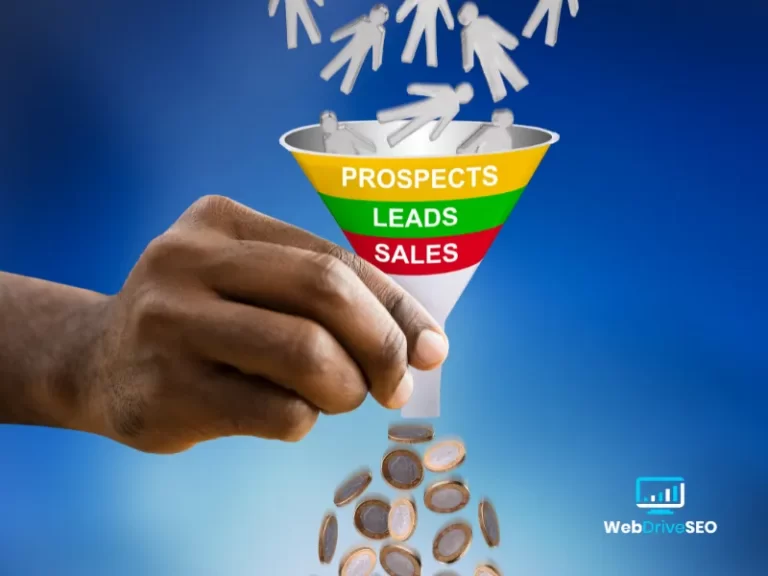
Do you have an impressive website with a steady flow of traffic? But sales are not rolling in! Not sure what to do next?
With conversion rate optimization, you can improve your website without adding more content or upgrading your strategy to get more traffic. WebDriveSEO explores 10 conversion rate optimization best practices that give you tools to drive more sales and get more revenue from the website traffic you already have.
What is conversion rate optimization?
The definition of conversion rate optimization is increasing the percentage of website users who perform a desired action on your site. These desirable actions might be making a purchase, completing a form, or subscribing to a journal.
It’s a good sign when online business owners ask, “What is conversion rate optimization?” It indicates that you are headed toward increasing conversions and maximizing your return on investment. For many website owners, CRO optimization is the guaranteed step to improving business outcomes.
Why is conversion rate optimization so important?
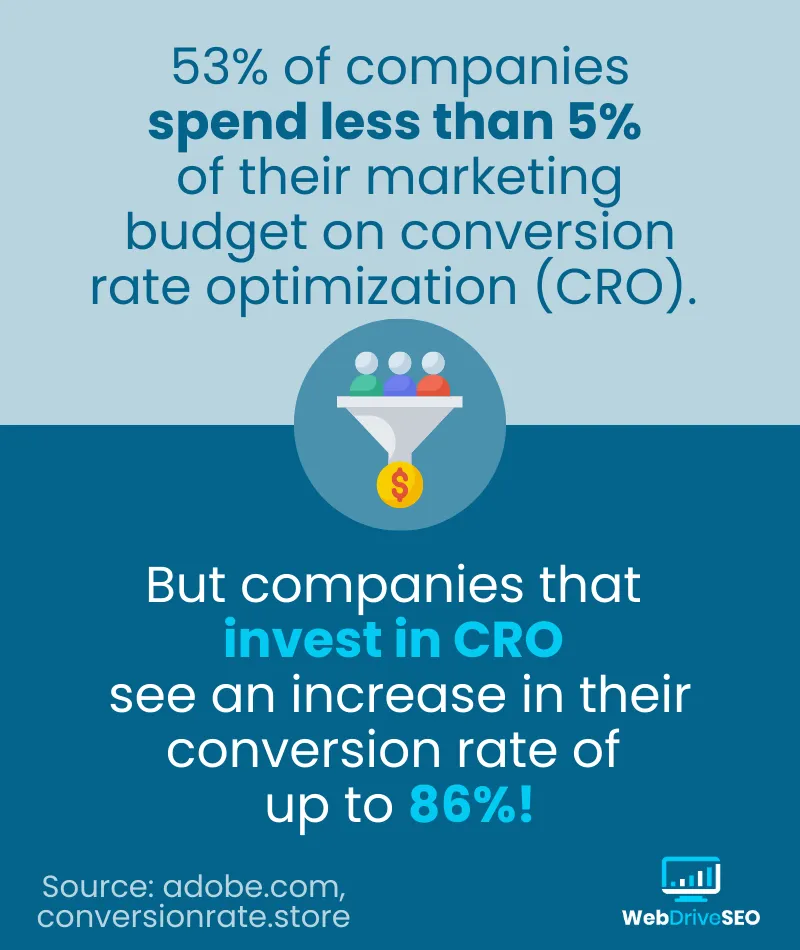
Your website conversion rate is very important because it helps you increase value from the visitors and users you already have. Since people have come to your site, it means it has something to offer them. Harvest all the effort you put in so far. Use CRO techniques, and bring users down your sales funnel to generate more sales.
By using CRO tools, you can increase your return on investment. Conversion rate optimization in SEO (SEO CRO) gives you a better understanding of your customers’ behavior and increases revenue while decreasing average customer acquisition costs.
What is a good website conversion rate?
The average conversion rate for organic SEO for a website is between 2% and 5%. If you have a conversion rate above 5%, that is really great.
Website conversion rates from organic SEO really are not uniform, as conversion rates vary and are affected by:
- the industry
- your marketing source
- the value of the service.
CRO on-page optimization depends greatly on how much effort is invested into a conversion optimization strategy. A ‘good’ conversion rate will be if you achieve your conversion goal for your website. For example, some experts say that an SEO conversion rate of 3%+ should be your goal for an online store, with 3.68% being the average global conversion rate across all industries.
How to calculate website conversion rates
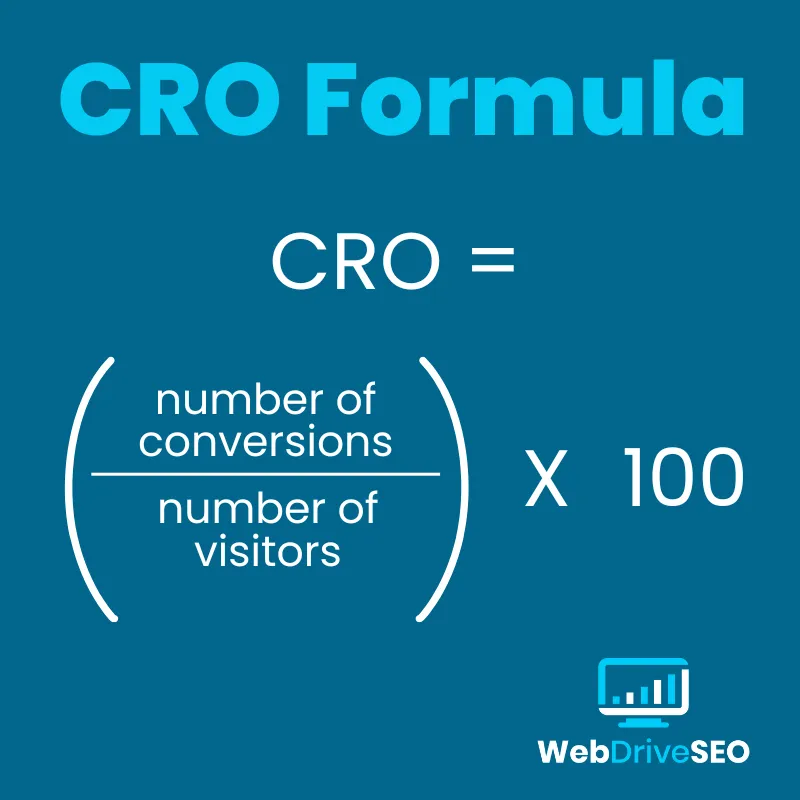
The calculation for the website conversion rate is as follows:
Conversion Rate = Number of Conversions divided by Total Visitors X by 100.
You can also use an automatic online conversion rate calculator.
Here are some steps to calculate your current conversion rate:
One: Decide on a set time period when you will measure the conversion rate.
Depending on your niche, choose as little as 2 weeks or as much as 3 months (a year quarter).
Two: Define a specific action as ‘conversion.’
It could be:
- Subscription – to an email, blog, or newsletter that you send out.
- Registration – for a class, a webinar, or an in-person event.
- Form completion – a contact form with personal information or a free downloadable gift.
- Following your social channel.
- Purchasing your product or service online.
Three: Collect the data.
Count how many people subscribed, registered, sent in forms, or purchased your product or service. You can set up tracking for these conversions via Google Tag Manager to view this data in Google Analytics 4 or through a premium provider such as Crazy Egg or Visual Website Optimizer. These websites will also show you the total number of website visitors.
To make the calculation, divide the number of conversions you had in the time period you have chosen by the total number of website visitors for the time period you have chosen and times by 100. Once you have calculated your conversion rate, compare your rate against the average CRO rates in your industry. Then, leverage these metrics by applying conversion rate optimization strategies. Finally, at a later date, calculate your conversion rate again to see if these strategies were successful in increasing your conversions.
10 conversion rate optimization best practices to drive conversion
When discussing how to improve conversion with conversion rate optimization strategies, there are no limits. Anything is possible with CRO techniques done right. Here are some conversion rate optimization tips that can boost your conversion rate.
1. Put customer experience first.
One of the most effective ways to increase conversion is to improve the customer experience. Enhance your customer experience by ensuring every stage of the customer journey is smooth and easy. Minimize the number of steps involved in generating a sale, and keep loading, search boxes, and other on-page elements up to speed. Studies show that users leave the site if they have to wait more than 2 seconds for page loading. And 27% of users will abandon an online shopping experience because the checkout process is too long.
2. Make website conversion rate changes only once you have real data about your users.
Use analytics tools such as GA4 to manipulate user data. This helps you to understand your customer’s online journey, such as where they drop off in the sales funnel. You can optimize your site accordingly, confident in the knowledge that all your changes are evidence-backed. Collect data with A/B testing and multivariate testing – the most popular ways to compare the conversion rate from different headings, content strategy, slogans, CTA, and graphic choices. Split URL testing is used to compare different versions of landing pages. There are many tools for testing your website, including extremely visual tools such as heatmaps that show exactly where users focus on the screen. As an example of the importance of changes being data-driven – Netflix once wrote that their product changes are driven by data collected as part of their “empirical approach” and not by “opinionated and vocal Netflix employees.”
3. Personalization is a favorite tool for conversion rate optimization companies.
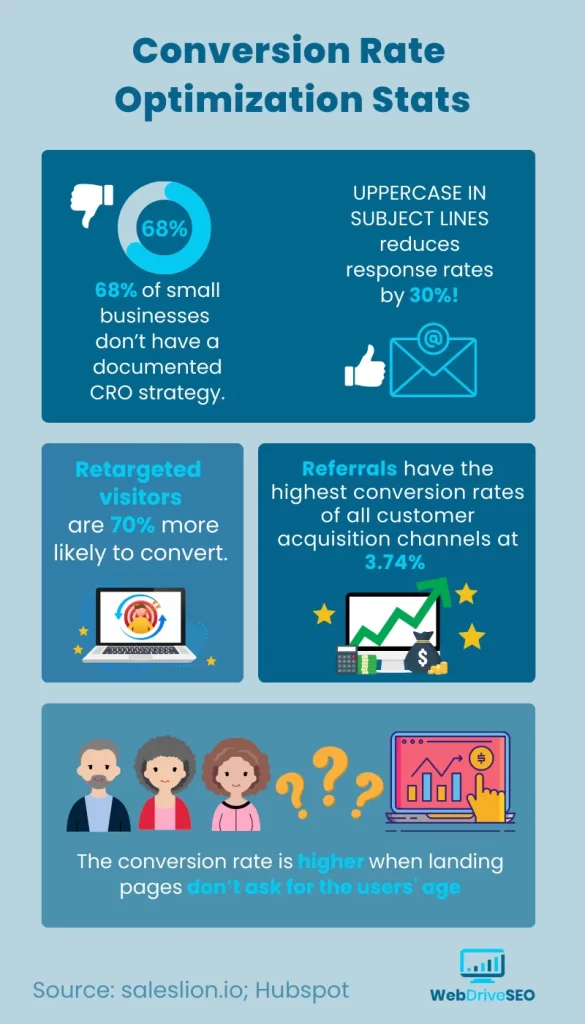
44% of users who see their name on the screen are likelier to become repeat buyers. And 54% of users prefer a personalized UX to a generic one. You can incorporate personalized marketing strategies and watch those conversions happen. Some examples of personalization are on-screen birthday wishes and special offers and deals in real time on product recommendations based on user data.
4. Conversions can happen even after the user has dropped off.
Abandonment emails that are sent to users who abandon their online shopping cart can also be a source of conversions. Research shows that abandonment emails have a conversion rate of 18.54%, second only to campaigns that email the cart to users, which boast a 24.58% conversion rate.
5. Use conversion rate optimization strategies to retarget returning visitors.
Visitors often return to a site, on average 3 times before they convert. Provide information to visitors – especially if they are returning visitors (perhaps a bot that pops up with helpful information the user was missing in their last experience.) Incorporate tools to store information about the visitor’s previous experience, be it registration forms, shopping carts, or other details.
6. Add support and chat messages.
Use live chat features on your website to offer customers help and support when they need it most while deciding whether to buy your product or service. Make sure to add these chat and customer support features to your highest converting pages; this may be your pricing or registration pages. Expect an increase in conversions.
7. Use email marketing automation.
Welcome emails have a conversion rate of about 0.94%, and they are much more effective than general marketing emails that only have a sales conversion rate of 0.10%. Three-quarters of customers expect to receive a welcome email. Leverage this amazing opportunity by including an offer in the welcome email. Welcome emails with an offer can bring you a 30% increase in sales compared to plain welcome emails.
8. CRO website optimization experts advise inclusion of visual content.
Adding 360-degree rotating images has been shown to increase conversion rates by up to 27%. Another example is adding product videos, which increases conversion by 134%. The importance of visual content is well known – dedicated, branded images add interest and build brand familiarity; they also help users understand your content which can increase conversions.
9. Integrate customer reviews.
Conversion rate optimization agencies use user-generated content (UGC) as it increases conversions across all industries, especially in the apparel industry, where UGC increases conversions by 207%. Adding customer reviews adds to your online reputation and trust, which itself significantly boosts CRO.
10. Hire a conversion rate optimization consultant.
Use a conversion rate optimization agency such as WebDriveSEO, the conversion rate optimization experts, or an experienced CRO consultant who will offer you conversion optimization strategies and insights based on your customer behavior. Conversion rate optimization experts are up to date with the best CRO practices and have hands-on experience with CRO techniques that are most effective in each industry. This makes them a super valuable resource for improving conversion rates.

How WebDriveSEO, a conversion rate optimization agency, can help improve CRO
WebDriveSEO uses tailor-made conversion rate optimization strategies to boost your website’s conversion and give you an advantage over your competition. Beginning with a conversion rate optimization audit, WebDriveSEO shows you where you stand. We strategically apply website conversion rate benchmarks to help you drive your CRO goals. We set the CRO gears in motion using the conversion rate optimization best practices discussed and many more. To find out how WebDriveSEO can help you improve your conversion rate, schedule a FREE discovery call and start making your business dreams a reality.
Conversion Rate Optimization FAQs
What tools can I use to track CRO?
There are many free conversion rate tools available online. Some of these tools are Google Analytics 4 (GA4); VWO Insights; Heap Analytics; Mixpanel; Usability Hub; Intercom; Userpeek, Crazy Egg, Heat Jar, and many more. Before using a tool, make sure they are GDPR compliant; they will integrate with your website platform and are safe and secure.
How to create a conversion rate optimization strategy
Here are 4 simple steps to building a comprehensive conversion rate optimization (CRO) strategy.
1. Investigate your current conversion rate. Measure your conversion rate. If you have to collect your data using CRO tools, filter the data you collect, leaving you with accurate, organized, and usable conversion rate data that relates to your site.
2. Research your industry. Learn about what your goals and business objectives should be for a business in your industry. Make sure you stay on target with your personal CRO goals. Set your KPIs for each customer segment, mapping out specific customer personas for each customer segment.
3. Optimize CRO using hypotheses and CRO tools that focus on your chosen goals. First, plan and prioritize which aspect you will optimize and when. Implement your processes, keeping a careful watch on whether the tools and tactics are working as you expect them to. Confirm that the new data is being collected in a reliable and usable format.
4. Monitor your CRO efforts. Examine the reports you gathered and interpret the results of your testing. Compare and contrast the old results to the new ones. The most important stage might be this last step, where you draw your conclusions. Make a note of which conversion rate optimization best practices work and which ones you plan to avoid next time.


